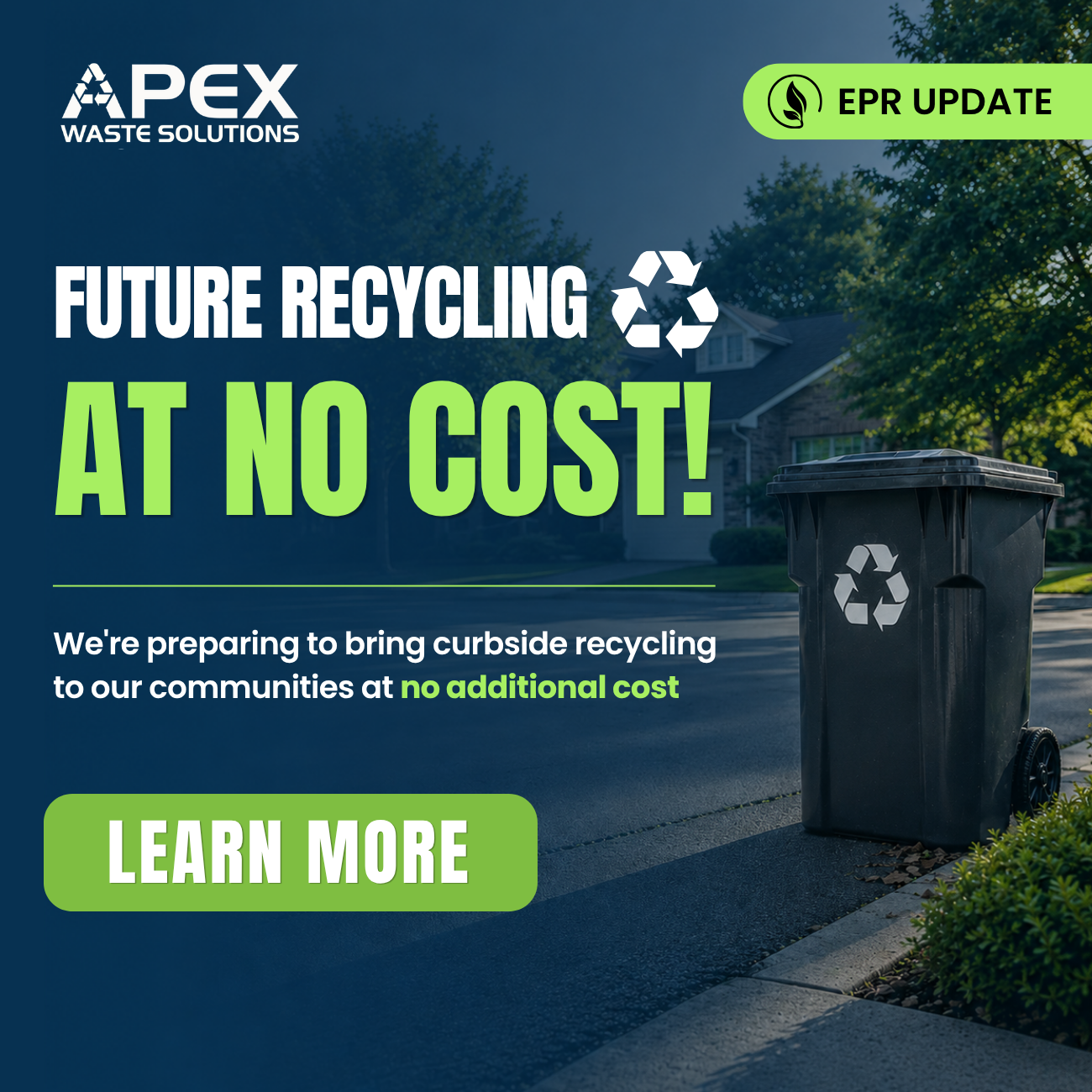
If you have heard about Colorado's new Extended Producer Responsibility program lately and wondered what it actually means for you and your trash and recycling service, you are in the right place. We want to explain it clearly, in plain language, so you know what is coming and what to expect from Apex Waste Solutions as this program rolls out.
The short version: Colorado passed a law that shifts the cost of recycling from residents and local governments to the companies that make the packaging in the first place. Over time, this creates the funding needed to expand recycling across the state, including to communities and households that have never had convenient curbside access.
For many Apex customers, that could mean recycling service coming to your home at no additional cost. Here is everything you need to know.
Where Did This Come From?
Colorado passed House Bill 21-1355 in 2021, establishing one of the most comprehensive Extended Producer Responsibility frameworks in the country. The law was created in response to a frustrating reality that most people never think about: in Colorado, recycling access has historically been inconsistent and expensive, especially in rural and suburban communities.
The people paying for recycling infrastructure have largely been local governments and residents, even though the companies producing billions of packaging units every year bear little of that cost. EPR flips that equation.
The companies that make the packaging help pay to recycle it. That is the core idea, and it is a straightforward one.
Under the law, producers of packaging and paper products, think beverage companies, food brands, consumer goods manufacturers, are required to register with a Producer Responsibility Organization (PRO) and contribute funding based on the volume and type of packaging they put into the market. That pooled funding is then used to build and sustain recycling systems throughout the state.
Who Oversees the Program?
The Colorado Department of Public Health and Environment (CDPHE) is responsible for implementing and regulating the EPR program. The law also established the Recycling Resources Economic Opportunity (RREO) program and created a framework for a Producer Responsibility Organization to manage the day-to-day collection and distribution of producer funds.
Colorado CDPHE — the state agency overseeing EPR implementation and compliance.
Producer Responsibility Organization (PRO) — the nonprofit entity that collects funding from producers and distributes it to recycling service providers like Apex.
Producers — companies that make packaging and paper products sold in Colorado.
Recycling Haulers — companies like Apex Waste Solutions that collect and process recyclable materials from homes and businesses.
The PRO acts as the financial engine of the system. Producers pay in, the PRO manages the funds, and haulers like Apex receive reimbursement for providing recycling service, which is what makes it possible to offer that service at no additional cost to residents.
What Kinds of Packaging Does This Cover?
The EPR program focuses on the materials that make up the majority of household recycling: packaging and paper products. This includes things like cardboard boxes, plastic bottles and jugs, glass jars, metal cans, paper bags, and the vast range of containers that consumer products come in every day.
The law does not cover all materials, and not every item currently accepted in recycling programs will necessarily be part of EPR funding. But the broad scope of covered packaging means that the materials most commonly collected in curbside programs are central to the program's design.
How Does the Rollout Work?
EPR programs of this scale do not happen overnight. Colorado's rollout is phased, with different milestones for producer registration, PRO establishment, funding distribution, and service expansion. Here is a simplified look at how the process unfolds:
Packaging producers register with the state and begin reporting on the types and volumes of packaging they sell in Colorado. This establishes the baseline for funding calculations.
The Producer Responsibility Organization gets up and running, begins collecting contributions from producers, and establishes contracts with recycling service providers across the state.
Recycling haulers like Apex receive reimbursement through the PRO, making it financially viable to offer recycling service to households at no additional cost to those residents.
The long-term goal is universal access to convenient recycling service for all Colorado residents, with producers funding the system on an ongoing basis.
Timing varies by community and provider. We do not yet have a confirmed launch date for our service area, and we will share updates as soon as we have them.
Why Does This Matter for Apex Customers?
Right now, not every Apex residential customer has recycling service. Some areas have it, some do not. Cost has historically been one of the barriers to expanding it further.
The EPR program directly addresses that barrier. By shifting the funding responsibility to producers, it creates a path for haulers to offer recycling service to households that currently only receive trash pickup, without passing the cost on to those residents.
For Apex customers in areas that do not currently have recycling, this is significant. It means:
- One 96-gallon recycling cart delivered to your home, serviced every other week at no extra charge. Need more capacity? An additional cart is available for a small monthly fee.
- Curbside pickup on your existing service day, no extra trips to a drop-off location required.
- No additional charge on your monthly bill for the recycling service itself.
- More opportunities to keep materials out of the landfill and support a cleaner Colorado.
If you already have recycling service through Apex, you will be automatically enrolled in the EPR program. No action needed on your part. The program may also bring improvements over time, including expanded accepted materials and more consistent service standards, as funding increases.
What Can You Recycle?
Standard single-stream curbside recycling accepts a range of clean, dry materials. The most common accepted items include glass bottles and jars, plastic bottles and jugs, paper and cardboard, and metal food and beverage cans. These materials make up the majority of what ends up in household recycling bins.
One thing worth knowing: not everything you might hope to recycle actually can be. Plastic bags, styrofoam, greasy pizza boxes, and food waste contaminate recycling loads and can cause an entire truckload to be sent to the landfill instead. Rinsing containers, keeping materials dry, and flattening cardboard all help make recycling more effective.
Wishcycling is when you toss something in the recycling bin hoping it will be recycled, even when you are not sure it actually can be. It is understandable, the impulse comes from a good place. But contaminated recycling loads create real problems for the entire system. When in doubt, throw it out. The most effective recycling is clean, dry, and sorted correctly.
What Should You Do Right Now?
Honestly? Probably nothing. Here is how it breaks down:
If you already have recycling service through Apex, you are all set. Nothing changes on your end, and your service will continue without interruption.
If you do not currently have recycling service, you do not need to do anything to participate either. As the EPR program rolls out across our service areas, recycling carts will be delivered and service will begin automatically in your zone. We will reach out ahead of time to let you know when to expect it.
The only reason to contact us is if you would prefer not to receive recycling service. In that case, just give us a call and we can note that on your account.
We will keep you informed as rollout dates get closer. When your area is coming up, you will hear from us first.
Information in this post reflects our current understanding of Colorado's EPR program as of publication. Program details, timing, and service availability are subject to change as the state rollout progresses. For the most current information on Colorado's EPR program, visit the Colorado CDPHE website.